
Dominga Cucul[1]
University of Belize
Omarielie Requena[2]
University of Belize
Frank Tzib[3]
Galen University
Mya Bolon[4]
Galen University
Tareek Smith[5]
University of Belize
Huzyra Cho[6]
University of Belize
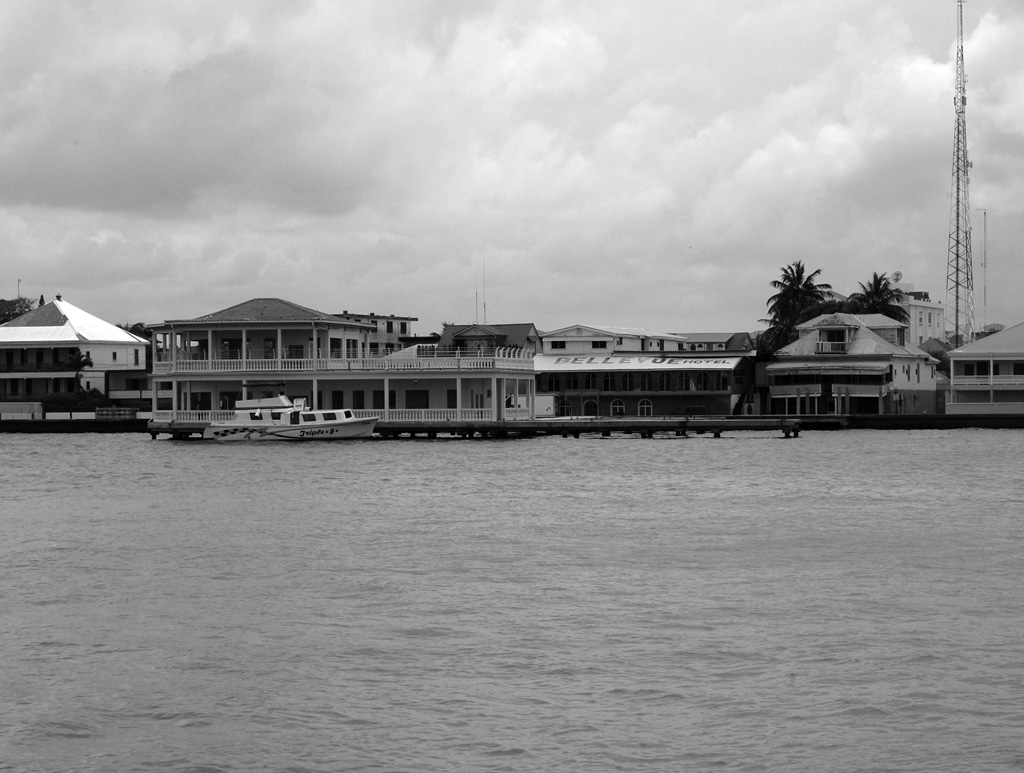
Waterfront of Belize City, Belize, from a boat. James Willamor, May 2007.
CC BY-SA 3.0. https://commons.wikimedia.org/w/index.php?curid=23289618
Abstract / Resumen
Indigenous participation in higher education remains lower than national averages in most contexts. In Belize, while 14% of the national population holds a higher education degree only 5% of Indigenous Maya achieve this level of education, whereas the rate for Indigenous Garifuna is 20%. Understanding the influencing factors, and identifying ways to improve participation is critical. An appreciation of the experience of Indigenous students who do attend university can help to address these issues, and the direct voices of students themselves can provide unique insights. In this paper we –a group of Indigenous students– share and reflect on our own experiences exploring the challenges, joys and struggles of our university journey as well as our hopes for the future of higher education.
Keywords / Palabras clave: Indigenous peoples; University life; Identity; Colonial history; Student voices
Introduction
Belize inherited exploitative political, economic, and social structures from the United Kingdom, which exercised colonial control over the territory for nearly two centuries (Shoman, 2011). Education, as a critical arena of cultural reproduction, was similarly shaped by the colonial project, which demonstrated minimal interest in educating the Indigenous peoples of Belize (Bennet, 2008). The structural marginalization resulting from this legacy remains evident in the realm of higher education. While 14% of the national population in Belize holds a higher education degree, only 5% of the Maya population and 20% of the Garifuna population attain this level of educational achievement (Statistical Institute of Belize, 2022). Indigenous students remain underrepresented, with these disparities rooted in enduring colonial legacies, systemic exclusion, and structural inequalities. In this article we share our experiences navigating higher education in Belize, which we hope sheds some light on how students negotiate their identities in these institutions. We discuss our experiences of cultural dissonance, the systemic barriers and personal transformations. We argue that Indigenous students actively negotiate their identities through an ongoing dialogue between personal heritage and institutional norms. Their narratives reveal intersecting themes of identity formation, cultural dissonance, systemic barriers, and personal transformation.
Our Positionality
This article is co-authored by five Indigenous students from the University of Belize and Galen University with help of Dr. Filiberto Penados and Mr. Delmer Tzib from the Indigenous Peoples Participation in Higher Education Research research team.[7] We were invited by the research team examining Indigenous participation in higher education to take part in focus group discussions and to collaborate in the writing of this article. As Indigenous young men and women currently enrolled in various academic programs at both institutions, we believe it is essential that our voices and experiences be documented and heard. We hope our collective reflections will inform future policies and initiatives aimed at making higher education more accessible and culturally responsive for Indigenous students. The paper is based on our group sessions but features the testimonies of two of us, Danielle and Olivia,[8] who were generous in authorizing the use of their stories. The stories of Olivia and Danielle epitomize our experiences. The use of the second person plural “we” refers to our collective; the first person singular refers to either Olivia or Danielle.
We come from the southern and central regions of Belize and are pursuing our studies either online or in person at the main campuses of our respective universities. Our circumstances vary: some of us have had to migrate to urban centers to pursue higher education, others commute from rural villages or towns, while a few live in close proximity to the institutions. Our cultural backgrounds are equally diverse, with representation from Garifuna, Q’eqchi’, Mopan, and Yucatec Maya communities.
Through our participation in the focus group sessions and subsequent discussions, we came to recognize both the diversity and the shared dimensions of our educational journeys. For the purposes of this article, we focus on the lived experiences of two female members (Olivia and Danielle) of our group which we believe are in many ways representative of our stories. One resides near her institution, while the other temporarily relocated to an urban area to attend university. Their narratives serve as information-rich cases that showcase our broader, collective experiences of navigating higher education in Belize.
Being Indigenous in Belize
We want to start with a brief reflection on what it means to be Indigenous. Belize does not have a legal framework for recognizing its Indigenous peoples. However, there is a general understanding that the Q’eqchi’ Maya, Mopan Maya, Yucatec Maya, and Garifuna are the Indigenous peoples of the country. Belize is a signatory to the United Nations Declaration on the Rights of Indigenous Peoples (United Nations, 2007), which serves as a guiding framework.
Being Indigenous, for us, means being “ourselves”. But who really can define what it means to be Indigenous better than the people themselves who live and practice the lifestyle. For me, Olivia, being Indigenous is “belonging to a community that shares values, resilience, and cultural continuity.” It is about “carrying the strength of our ancestors and honouring their legacies through the preservation of language, food, music, and knowledge.” Our definitions of Indigeneity traverses multiple layers of Indigenous identity. We anchor our sense of self in our community and a ‘sense of belonging’. Thus, being Indigenous is not merely a personal conviction but a collective identity shaped by our cultural and geographic contexts. Olivia’s words remind us that the markers of our identity and knowledge systems have been passed down through generations. Therefore, we find it obligatory to share, inform and educate our peers, our children and our neighbours of who we are and why we are the way we are. Being Indigenous for us, then, is about community, culture, and ancestral ties. We do not have to think about it, it exists naturally and unconsciously.
For many of us being Indigenous is an act of resistance. For Danielle, for example, “To be Maya is to be myself, to speak, to eat, to dress, and to dance.” Beyond that however, “I do not want to blend into a society that erases my identity. I will speak for and defend my people, our way of life, and boastfully identify as Indigenous.” In a way it is about fighting marginalization, about “defying the odds” that are against us. Like Danielle, for many of us being Indigenous is about refusing to assimilate, abandoning who we are and who our communities are. In many ways this is embodied in everyday processes of self-identification.
In sum, being Indigenous for us has to do with a sense of our community and our long historical roots. It is about honouring that heritage but it also about resisting the pressures to lose ourselves in our present society.
Going to the University
We agree that attending university is an opportunity, an experience, and a challenge that many of our peers do not have. Education has been instilled in all of us as a pathway toward uplifting both individuals and communities across Belize. Olivia and Danielle for example express having received strong encouragement from their families and teachers to pursue higher education. For Danielle, getting educated meant “getting a good job and a good pay.” For many of us, education is widely seen as a practical means of achieving economic stability and contributing to family and community well-being. Despite the marginalization and barriers our families and communities face, our families regard higher education as an important investment in the future of their children.
Many of our families and communities support us and this is to be celebrated. However, it is important to recognize that additional challenges persist, particularly for Indigenous women. For me, Olivia for example, although my university journey was supported, I was aware that in many communities, especially more conservative ones, women are still discouraged from pursuing higher education. In such communities, the men, or the fathers, place little or no importance on women getting educated as they are told that it is their future spouse who should be the providers. Often in our communities women are not regarded as “providers,” they are seen instead as “care givers.” In such contexts, entrenched community barriers and gender norms can hinder educational aspirations. However, these attitudes are gradually changing, and more Indigenous youth, both men and women are being encouraged to attend university.
In Belize, however, encouragement alone does not guarantee access to higher education. Financial support remains essential to cover tuition, books, transportation, food, and housing. Especially, for some of us who have to relocate from our communities or travel every day, higher education is a heavy financial burden. Olivia’s experience is especially complex:
I (Olivia) am from a village in the Toledo District, approximately five hours from Belmopan, where I study. My participation in higher education requires securing funds to meet all my needs, including temporary relocation to the city. Fortunately, I have a financially stable family who is able to support my journey.
Danielle’s experience while sharing some similar challenges, is a little different:
I (Danielle) also encountered financial challenges but benefited from living close to the university, which reduced the need for major additional expenses.
Another significant barrier to attending higher education has to do with emotional, cultural and social challenges of leaving home and entering a different social and cultural space.
For me, Olivia, as for many students, attending university entails not only physical relocation but also significant social and psychological challenges. This included being in a place that was culturally different and also not having the emotional support of my family.
Many of us, like Olivia, must leave our communities and adapt to urban life, where we are expected to navigate unfamiliar academic expectations, social norms, and institutional environments. These demands are further compounded by homesickness, separation from family and friends, and the absence of familiar cultural spaces. We sometimes have to pay a heavy price. For Olivia, for example, “relocation led to a growing sense of distance from aspects of my cultural heritage… I felt I had neglected participation in traditional practices and community life.”
The family and community influence serve as powerful motivators for Indigenous students to participate in higher education. However, this support and encouragement also needs to be accompanied by other forms of support to deal with emotional, structural and emotional challenges.
Our experiences underscores the need for structural and holistic responses that include financial aid, culturally responsive support systems, and efforts to bridge the gap between academic life and Indigenous identity.
Throughout the process of accessing higher education, students negotiate their identities through an ongoing dialogue between personal heritage and structural norms.
Navigating Higher Education
Our discussion provides some insights into the wider societal pressures in attending higher education. Within the university space, we face other challenges and opportunities. We negotiate our identities daily within our university space; where, we are tasked with balancing our identities and the demands of the institutions. Our universities privilege a Western view of education that minimizes our experiences. We have to find strategies to balance maintaining cultural norms and obtaining our degrees in Belize. We must emphasize that though we face challenges, we do not stop being Indigenous because we are obtaining a degree. We negotiate our identity, to remain grounded and pursue our dreams.
Feeling Invisible
We many times feel invisible in formal education. It is our reality, many of us feel alienated from. We are forced into a system where cultural identity, perspectives and experiences are often ignored, undervalued or plainly suppressed. The feeling of “not fitting in” can be very overwhelming and oppressive. Danielle, for example reflects about how she felt at the university:
I felt “too simple”… I did not fit in. I felt that people looked down on me and that I did not meet the expectations of the university. This made me feel inadequate and out of my comfort zone.
Similarly, Danielle reflects on feeling alientated:
The value of going to the university for me was initially to fulfil the need of paving a career path. However, when I began, I quickly realised that I was different. There are many aspects, but the one I want to highlight is the obvious of being too “simple”. Though it was never verbally said to me personally, the generalization in class directly hit me. Maybe I can say that the phrase “if the hat fits, wear it” really made me wear that invisible “hat.” I know, I know, the university is there to teach us, mould us rather, to work in the corporate world and we must look and sound a certain way if we want to excel in that type of world.
Our reflection provides insights into the tough scenario we face as Indigenous students. We experience institutional spaces that sometimes tell us we are not good enough, that seek to mould us into something different as we seek to realise our aspirations of getting higher education. We cannot ignore the impact of colonial legacies on social realities of exclusion that we must overcome to build a career. As Danielle shares in her reflection:
I felt alienated in my own country. I stepped into a new space governed by dominant power structures and cultural norms that differed significantly from what I had experienced. My feelings of being “simple” or not fitting-in reveal a deep sense of being “othered.” I not only felt different but perceived that others in the university setting saw me differently. Although no one confronted me directly or verbalized exclusion, the pervasive sense was that I did not belong. This led me to feel that I needed to make significant changes to be accepted.
Although I Studied Business Administration and understood the expectations of corporate work, I found that these expectations did not align with my cultural background. My experience underscores a broader mismatch between institutional demands and the realities of our communities. Upon entering university, I was measured against dominant norms shaped by popular and urban culture. My account demonstrates that, while the university may not have been explicitly exclusionary, it implicitly rendered me invisible by privileging dominant ways of knowing, being, and behaving.
Danielle’s narrative sheds light on how the formal and hidden curriculum collectively contributes to the marginalization of our people. The formal curriculum, its content and philosophy is often far from our lived experiences. It is designed instead to produce individuals to enter the labor market. The hidden curriculum, through its norms and unspoken expectations, further marginalizes our identity. For instance, professional standards around dress, speech, and conduct are sharply contrasted with our everyday experiences, reinforcing a divide between institutional norms and our cultural reality.
Dianelle’s reflection highlights that higher education can sometimes be spaces of assimilation into dominant society. We face institutions that seek to mould us into a predefined image of success, one that requires us to conform in appearance, behavior, and language. This process inevitably entails a loss of individuality and cultural connection. Our experiences highlight the tension between formal education and cultural identity, illustrating the emotional and psychological negotiation required to advance academically while remaining rooted in our Indigenous identity.
Our experiences raise a lot of questions about whose identities are affirmed in higher education and how institutional cultures can alienate us students from rural, Indigenous, and lower-income backgrounds by pressuring us to assimilate. More broadly, they reflect the absence of Indigenous ways of knowing in educational structures and the neglect of cultural considerations. Our experiences are examples of the psychological and cultural costs of participating in institutions that are not always inclusive.
Academic pursuits can often lead to a sense of disconnection from our communities. As Olivia points out,
Within the university, there are limited opportunities to celebrate my identity or build a supportive Indigenous community. At the university, I do not feel understood or valued, as the institution fails to provide spaces or learning environments that foster a sense of belonging.
Linguistic Alienation
Attending university in Belize automatically entails using English as the dominant language. This poses an important challenge for us, who do not have English as our first language. To cope with educational demands, we are forced to learn and practice English to the detriment of our languages. This means that we are faced with the reality that our languages are undervalued, discredited and discarded as useless. This further impacts our identity, we are told that our language, a key marker of our identity, is irrelevant in this space. The subjugation of the language leads us to feel inferior and we slowly stop talking our language, especially at the university.
The hidden curriculum also places pressures within and outside of the classroom for us to assimilate. English in this case prevents our full participation in higher academic discussions. This is reflected in Danielle’s experience
I understand English, but I don’t always feel confident speaking it, especially in front of the class. I worry they think I am not smart. I had gone through a psychological and emotional pressure due to feeling insecure. My confidence level declined whenever I was required to speak English because I was not fully comfortable.
This shows that language is connected to us feeling worthy and feeling open to participate in class. Language becomes a gatekeeper for us to be recognized within the academic space. Being smart often means being able to speak English, while speaking our Indigenous language perhaps means the opposite. This reveals how language insecurity can lead to silence in the classroom and limit our engagement.
Olivia’s experience further illustrate the language challenges:
When I entered university, writing essays in English was hard. We didn’t write like that in high school. For me, not having English as our first language impacted my ability to write well and communicate in the language. In many classrooms, we are encouraged to practice English and discouraged from talking our language.
Olivia further observes that “It’s like they expect us to leave our language at the door. That part of us is not welcome.” This shows that the university aims to erase who we are. It does not give opportunities for us to share our languages within the educational spaces. The language as an important barrier is also a space for negotiating identity. Some of us consciously decide to stop speaking our language, while others consciously decide to continue sharing it.
Our experiences show that language can be a barrier and alienate us. The university and it’s structures consciously or unconsciously place a higher value on aspects that contribute towards cultural erasure. Universities need to start creating spaces to celebrate and share the languages that are at the core of our identity.
Lack of Support for Indigenous Students
Higher education settings are often not inclusive or adequately responsive to our needs. They do not have dedicated support systems within universities that are necessary to foster our success. We know that there is a lack of targeted mentorship, dedicated scholarships, and open spaces for the affirmation and celebration of our identities. This absence shows that institutions in words treat us equally, but they fail to implement practices that support equity in reality. By applying a one-size-fits-all model, educational institutions overlook our difference and disadvantage us.
The curriculum in these institutions largely excludes our knowledge systems, languages, and histories, leaving little room for us to see ourselves reflected in the academic content. This exclusion reinforces our marginalization and sends a clear message that our contributions are not valued within the academic space. When curricula are not culturally relevant, we are placed in a position where we must either conform to dominant norms or remain silent. This creates an environment where academic participation becomes a negotiation of identity, often at the cost of being ourselves.
The lack of culturally responsive mentorship is another significant gap we identify. It is important for us to have mentors who understand our background and can provide guidance that is not just academic but also emotional and cultural. The absence of Indigenous mentors or allies who are equipped to support us through challenges such as cultural dissonance, language barriers, and financial hardship leaves us feeling isolated and unsupported. Appropriate mentorship could offer a sense of belonging, validation of cultural identity, and practical strategies to navigate the academic system without feeling pressured to abandon one’s roots.
We also note that there is need for structural changes within higher education to accommodate and affirm our realities. Our experiences reflect a broader systemic failure to acknowledge that we come with specific challenges and strengths that must be recognized through intentional support. Institutions must move beyond rhetoric and implement policies, programs, and spaces that actively center our perspectives. This includes developing Indigenous student services, revising curricula, hiring Indigenous faculty, and investing in scholarships and mentorship models that are culturally grounded.
Higher education holds the potential to be a transformative space, but transformation must be inclusive and culturally affirming. Empowerment through education should not require us to sever ties with our identities, languages, and communities. Instead, it should enable us to thrive academically while remaining rooted in who we are. Failing to create such inclusive environments risks alienating the our higher education claims to uplift. Therefore, structural change is not optional, it is necessary for creating an educational system that is truly just and equitable.
Final reflections
Attending Higher Education institutions is a privilege that brings several challenges to us. We have attempted to outline our experiences for the readers to become aware of the challenges we face in the process of obtaining higher education. This essay has demonstrated that attending the university requires us to negotiate our cultural identities with the demands and norms of institutions. We are forced to negotiate within our communities, the university structure, the curriculum, and even as it relates to language. Through sharing our voices, we hope to advance changes in our systems and create inclusive spaces. Changes such as financial support, psycho-social support, targeted academic support for Indigenous clubs, Indigenous mentorship programs and inclusion of Indigenous Knowledge in the curriculum would be a good place for educational institutions to start.
References / Referencias
Akbulut, N., & Razum, O. (2022). Why Othering should be considered in research on health inequalities: Theoretical perspectives and research needs. SSM – Population Health, 20, 101286. https://doi.org/10.1016/j.ssmph.2022.101286
Bennet, A. (2008). Education in Belize: A Historical Perspective. The Angelus Press.
Martinez-Cobo, J. (1986). Study of the problem of discrimination against indigenous populations: Final report. United Nations. https://www.un.org/development/desa/indigenouspeoples/publications/martinez-cobo-report.html
Shoman, A. (2011). 13 chapters of a history of Belize. The Angelus Press.
Statistical Institute of Belize (2023). Belize Population and Housing Census Country Report 2022.
United Nations (General Assembly) (2007). United Nations Declaration on the Rights of Indigenous Peoples. https://www.refworld.org/legal/resolution/unga/2007/en/49353
- Correo electrónico: 2015112106@ub.edu.bz ↑
- Correo electrónico: 2019119900@ub.edu.bz ↑
- Correo electrónico: ajtzibmasewal@gmail.com ↑
- Correo electrónico: mbolon@galen.edu.bz ↑
- Correo electrónico: 2023159427@ub.edu.bz ↑
- Correo electrónico: 2024161818@ub.edu.bz ↑
- Research team implementing the IDRC funded project “Supporting policies and practices for indigenous groups in institutions of higher education and academic research in Central America” led by Dr. Filiberto Pendos (Galen University).↑
-
(Danielle and Olivia are pseudonyms) ↑